
How a Global Design Team Achieved Continuous Collaboration for Quick Problem Solving
When an urgent sub-assembly issue surfaced with a contract manufacturer overseas, the usual workflow could not keep pace. Thanks to this tech, what would have taken days was resolved overnight.
Edited by EE Staff
Cool Stuff
Jun 4, 2026
Axon develops TASER devices, body-worn cameras, and evidence management software. To keep production on track, Axon design teams need to spot and fix manufacturing problems quickly and efficiently. When an urgent sub-assembly issue surfaced with a contract manufacturer overseas, the usual workflow could not keep pace.

A design engineer based in East Asia spotted a condition that only showed up in the full assembly. The contract manufacturer could not see what he was seeing. Historically, closing a dimensional analysis and GD&T (geometric dimensioning and tolerancing) gap like this meant a long relay of operations: scan the part, analyze it in desktop software, export large files, send them to the partner company, then wait for the next workday to keep going. Each turn burning another day of time.
Continuous Collaboration
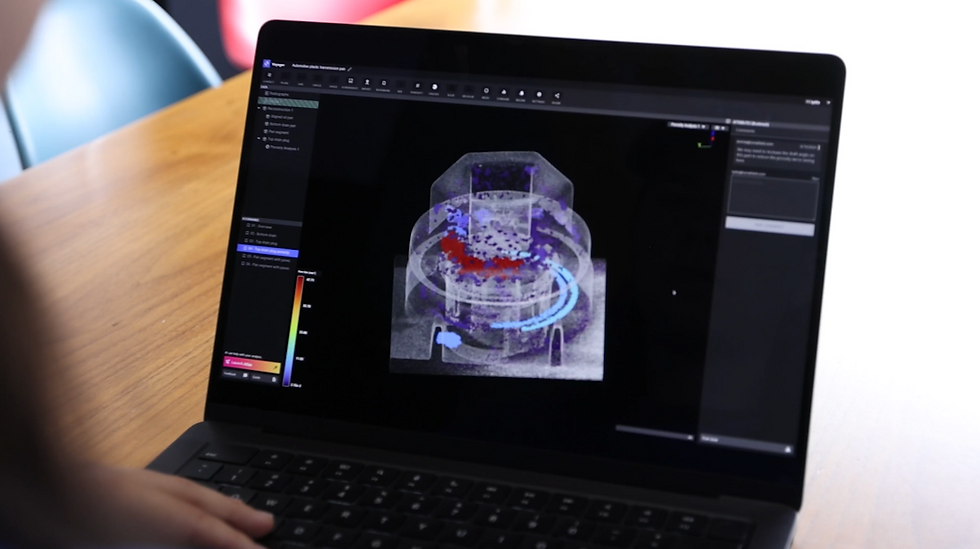
Ian Toal, Axon’s Test Engineering Manager, recognized that there was a faster path to completing the operation in less time. First, he ran a high-resolution scan on Axon’s Waygate CT scanner, then uploaded the data to Voyager with Uplink, and shared a link. Not only did the process involved no oversized file packages, it provided immediate access to the source data.

The engineer in East Asia, new to Voyager, opened the scan and started work immediately to solve the issue. Ian’s bookmarks pointed to the suspect regions, so no extra instructions were required. Overnight, the engineer was able to complete his analysis and leave clear annotations. When Ian logged on the next morning in Phoenix, AZ, the failure mode was documented and the next steps in solving the issue were obvious.
Ian Toal explained, “Without Uplink, there would have been no way we could have solved the issue this fast. It would have been a bunch of back and forth with day-long interruptions.” Using Voyager and Uplink, Axon’s team operated as a continuous 18-hour unit, each person picking up exactly where the other left off. What would have taken days was resolved overnight.

Many engineers still rely on old file-sharing habits because they have not tried a browser-based workflow for CT data. This project proved how quickly a first-time user can become highly effective. There is no software to install and no waiting for transfers. Voyager offers direct access to CT data anywhere in the world, with real-time comments, measurements, and shared context.
For Axon, Voyager has become a straightforward way to turn CT data into decisions.
For information: