
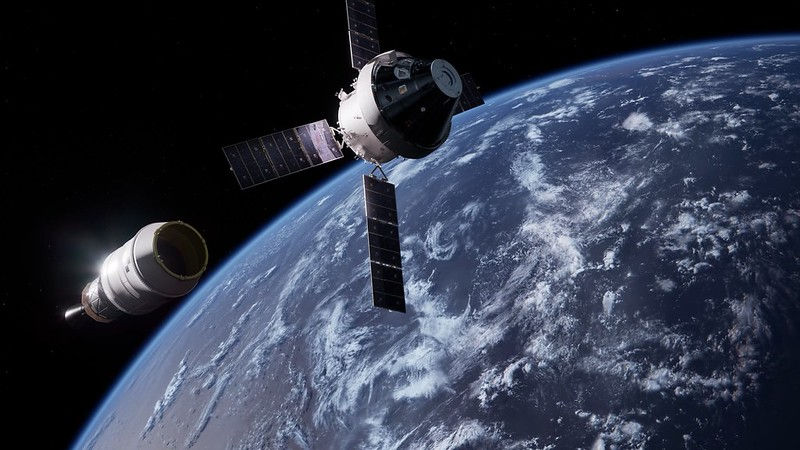
The Autonomous Choreography Behind Docking Orion
In NASA’s Artemis campaign, Orion is the only spacecraft capable of taking humans from Earth to lunar orbit. Docking is a dance between precision and timing.
Edited by EE Staff
Cool Stuff
Mar 9, 2026
Orion’s unique design allows it to seamlessly maneuver and perform safe and precise docking with different types of spacecraft, such as SpaceX’s Starship human landing system, Blue Origin’s lander, or even other vehicles if needed, including habitats and propulsion systems. This capability is crucial for enabling the transportation of crew and cargo between different spacecraft, as well as for facilitating the assembly and servicing of spacecraft in deep space.

According to Harvey Mamich, Orion guidance navigation and control manager at Lockheed Martin, “Docking is like a choreographed dance of timing to make everything work. If Orion or the other vehicle drifts from its position, Orion has to readjust based on a variety of information, figure out where both vehicles are located, and conduct thruster burns to get back in the right spot. Everything must work together seamlessly and autonomously.”
The activity of a spacecraft approaching, interacting, and connecting to another spacecraft is known as Rendezvous, Proximity Operations, and Docking (RPOD), and Lockheed Martin is working with NASA to develop and test the latest RPOD generation for Orion.

RPOD systems are used on an array of spacecraft and incorporate a combination of sensors, cameras, and computers to guide the vehicle into the correct docking position. Software and hardware components work together to provide real-time data on the spacecraft's position, velocity, and attitude. Orion’s RPOD systems utilize Light Detection and Ranging (LiDAR) technology, which generates high-resolution maps of the docking environment. This enables the system to navigate the spacecraft with greater precision and accuracy.
LiDAR provides the position information of the target vehicle, and as Orion goes through the entire docking procedure from a far distance out down to the two vehicles touching, LiDAR provides locational data while making continual automatic corrections to ensure the two spacecraft are docked perfectly.
Where earlier docking systems relied on manual operation with limited automation, Orion's RPOD system incorporates LiDAR targeting retroreflectors to enable automated docking with a high degree of precision. The automated docking process—controlled by the LiDAR and resident software in the system—drives the thrusters to maneuver the Orion into place. For safety, an optional manual override can be activated by crew members if necessary.

Testing Using Drones and Robots
Testing and simulation of Orion's RPOD system were recently conducted at Lockheed Martin’s Space Operations Simulation Center (SOSC) in Denver—a testing facility where engineers can replicate the operational conditions of space—as well as at large open-field ranges at Lockheed Martin’s Santa Cruz, CA facility. Engineers at Lockheed Martin plan for different scenarios that Orion and the Artemis crew will encounter during a variety of missions, then use these facilities to put the RPOD system through a rigorous test regiment.
For example, custom-built drones outfitted with 3D-printed parts simulated the separation distance of multiple target reflectors—think moving targets at a shooting range—near a docking port. Orion’s RPOD LiDAR system was deployed in a fixed trailer on the coast, tracking the motion of the moving drones out over the Pacific Ocean.
The drones were flown in a variety of approach paths toward the trailer, ranging from 10 meters to further than one kilometer, at varying speeds and angles similar to how Orion would approach another spacecraft. This enabled the team to simulate rendezvous approach tracking, holds, and unexpected conditions.
The second part of the RPOD testing incorporated the cameras and was performed at the SOSC using its large 50-foot-tall robot running along a 180-foot-long track. These tests were designed to fine tune the limits of the system’s performance and to evaluate its ability to maintain accuracy down to centimeters in distance. The LiDAR’s field of view is typically narrower at close range, which makes it more sensitive to misalignment.
Orion is poised to undertake a series of critical missions in support of NASA’s Artemis program. The spacecraft is scheduled to play a key role in the Artemis III mission, slated for launch in 2027, which will dock with the lander while in orbit around the Earth. This sets up a mission to land astronauts on the surface of the Moon in 2028. With the Moon in its sights and Mars in the near future, Orion—carrying humans and docking with a variety of vehicles—will be a critical element of NASA’s Moon to Mars efforts.
This just in: NASA recently announced that it is increasing the cadence of missions under the Artemis program to achieve the national objective of returning American astronauts to the Moon and establishing an enduring presence. This includes standardizing vehicle configuration, adding an additional mission in 2027, and undertaking at least one surface landing every year thereafter.
For information: