

The Precise Engineering Behind an Emergency Training Center for First Responders
It takes technological sophistication to create controlled chaos that mirrors the unpredictability of real-world emergency response, while maintaining uncompromising safety and reliability.
Braden Steiner, Associate Principal
Cool Stuff
May 26, 2026
Standing at the edge of the river channel at the North Carolina Emergency Training Center (NCETC), with live aircraft fire testing unfolding in the distance, the gravity of the mission becomes immediately clear. This is not a themed environment designed to simulate danger—it is a purpose-built landscape where realism is essential, stakes are high, and engineering precision directly supports life-saving training.

Located at the Stanly County Airport in New London, North Carolina, the NCETC is envisioned as one of the nation’s most advanced first-responder training campuses. The facility supports Aircraft Rescue and Firefighting (ARFF), swift water rescue, urban search and rescue, hazardous materials response, and fire investigation, all within a fully integrated environment.
Under the authority of the North Carolina Office of the State Fire Marshal, the project brought together a multidisciplinary team including Calibre Engineering, BNA Consulting (now Resolut), AE Urbia, Timmons Group, and Cloward H2O which was the aquatic and hydraulic systems specialist. Since its initial announcement in 2017, the project has grown substantially, expanding from an original $28 million allocation to a total investment of approximately $87 million, with construction accelerating in 2023 and full operational readiness achieved by the end of 2025.
Engineering the Water Systems
From an engineering standpoint, the water systems presented both the defining challenge and the defining opportunity of the project. The facility required swift-water environments capable of producing variable currents, turbulence, eddies, standing waves, and downstream recovery zones—conditions that could be carefully tuned for novice instruction or intensified to replicate the force and volatility of real flood and river rescues. These aquatic environments had to coexist seamlessly with aviation fire trainers, burn pits, aircraft mockups, smoke systems, and structural collapse props, all while conforming to strict safety, environmental, and permitting requirements.

Achieving this level of realism began with extensive hydraulic modeling. Advanced computational fluid dynamics and three-dimensional flow simulations were used to study current behavior, turbulence zones, and velocity profiles long before concrete was poured, or pumps were specified. These models informed the shaping of banks, placement of baffles and weirs, nozzle configurations, and interaction with training obstacles such as rockwork and debris elements. Just as critically, the system was designed with adjustability in mind—recognizing that no simulation perfectly predicts real-world behavior once water begins moving through a physical environment.
Flow control across the campus is achieved through a coordinated network of variable nozzles, spill weirs, control gates, and valve banks that allow instructors to fine-tune conditions in real time. High-flow primary pumps deliver the volume needed for aggressive rescue scenarios, while mid-range pumps and variable frequency drives allow efficient operation during lower-intensity training. Redundancy is built into every critical system, ensuring that no single mechanical failure can compromise operations. Soft-start sequencing, surge control, and bypass loops protect both infrastructure and trainees as the system transitions between idle and full-throttle states.
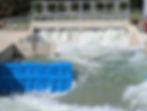
Equally critical is water quality management. Because trainees are immersed in these environments, the systems were engineered to maintain consistent clarity, chemistry, and sanitation while tolerating heavy turbulence, sediment loads, and debris. Filtration trains, disinfection systems, pH control, sediment settling zones, and controlled make-up and bleed-off strategies work together to protect both human health and long-term equipment performance. These systems are designed not only for peak performance, but for decades of reliable operation under demanding conditions.
Automated Systems
At the heart of the facility is a robust automation and control architecture. A PLC- and SCADA-based backbone monitors flows, pressures, water levels, pump status, valve positions, and water quality metrics across multiple zones. Training supervisors can adjust scenarios through intuitive human-machine interfaces, while layered interlocks ensure that unsafe conditions trigger immediate, coordinated shutdowns. Redundant sensors, communication pathways, and data logging provide both real-time situational awareness and long-term performance insight, allowing operators to adapt scenarios dynamically while maintaining strict safety margins.

Integration with the broader site was a constant focus throughout design and construction. The water systems are inseparable from the surrounding civil, landscape, and architectural elements, and subtle changes in grading, embankments, or drainage can significantly influence hydraulic behavior. Close coordination ensured that aquatic zones blended naturally into the campus while remaining highly engineered beneath the surface. Maintenance access, stormwater management, structural supports, and visual cohesion were all addressed as part of a unified master plan.
Sustainability and operational efficiency were embedded into the design from the outset. Energy efficiency is achieved through precise pump modulation and demand buffering, while durable materials and protective coatings reduce long-term maintenance requirements. The system is designed to accommodate future upgrades, allowing new technologies or expanded training capabilities to be integrated without wholesale reconstruction. Continuous monitoring and feedback loops further support efficient operation and long-term resilience.
Like any project of this scale, NCETC presented risks ranging from hydraulic uncertainty to mechanical reliability, environmental compliance, and schedule constraints. These were mitigated through conservative design margins, physical mockups, phased commissioning, and early coordination across disciplines. The result is a facility that includes a full-scale 737 and C-130 ARFF trainer, a 3,500-gallon Jet-A hydrocarbon burn pit, and one of the most sophisticated integrated training environments in the country.
Now fully operational, the North Carolina Emergency Training Center stands as a benchmark for how engineering, technology, and realism can converge to support first responders in the safest possible way. For Cloward H2O, the project reinforced essential lessons: model early but design for adjustment, prioritize maintainability alongside performance, integrate deeply across disciplines, and never underestimate the importance of commissioning and real-world tuning. Above all, the work underscores the responsibility inherent in engineering environments where realism is not entertainment—it is preparation for moments that truly matter.
For information:
North Carolina Emergency Training Center