

Using Sound and Vibration Simulation for Vehicle Development
Advanced simulator allows vehicle developers to accurately experience the noise and vibration at every driver touch point to meet brand and customer expectations before building the first prototype.
Edited by EE Staff
Cool Stuff
Apr 10, 2026
Vehicle comfort, quality, character, refinement, and brand DNA are all communicated and perceived through sound and vibration. When it comes to purchasing a vehicle, consciously or not, people form opinions and make decisions based on sound and vibration while test driving. This is why it is critical to get these vehicle characteristics right the first time—or risk poor perception with customers and poor performance in the marketplace.
Like any other aspect of vehicle development, there are many ways to measure, analyze, and predict noise, vibration, and harshness (NVH) performance. However, unlike many attributes, NVH is not easily explained, understood or communicated simply through plots, graphs, numbers, and data.

For many NVH phenomena, vibration is a key element, and both sound and vibration need to be assessed at the same time—and at accurate levels—to make a correct evaluation and decision about the acoustic and tactile character of a vehicle. The VI-grade COMPACT NVH Simulator helps to make this happen before prototyping even starts.

The Simulator
To achieve an exceptionally stiff structure that is capable of delivering controlled and accurate vibration to the evaluator, the NVH Simulator incorporates carbon fiber materials extensively, including in the steering wheel. This provides extremely low mass and high stiffness. It has no rim modes below 200 Hz.

Seven independent inputs deliver vibration to the driver through the seat, steering wheel, and floor pan. This design maximizes the isolation of the seven distinct axes of vibration from one another, allowing for high accuracy and real-time driver-in-the-loop simulation. Embedded accelerometers are used for each axis of vibration to enable easy calibration and real-time feedback and monitoring capabilities of vibration levels.
Using the simulator, customers can get vibration and sound results of CAE models and hybrid CAE/Test-based models. Real-time experiences include powertrain vibration and sound for such operations as idle, wide-open throttle, cylinder deactivation, start/stop, and more. Road interactions include smooth road, rough road, and impact events providing both vibration and sound. Users can even complete A/B comparisons between vehicles or designs with instant switching.
When the COMPACT NVH Simulator is coupled with VI-NVHSim Software it brings NVH virtual prototypes to life. The software is designed to make it easy to understand and evaluate NVH data and to make decisions on NVH design iterations.
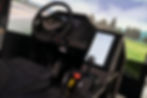
The simulator is available with either an immersive visual system, which includes a projector and large curved screen, or a space-saving ultra-wide curved display mounted on top of the simulator nose. A steering wheel with paddle shifters, pedals, a console-mounted shifter, dash screen, and console-mounted touchscreen enable driver input, interaction, and feedback.
For more information: